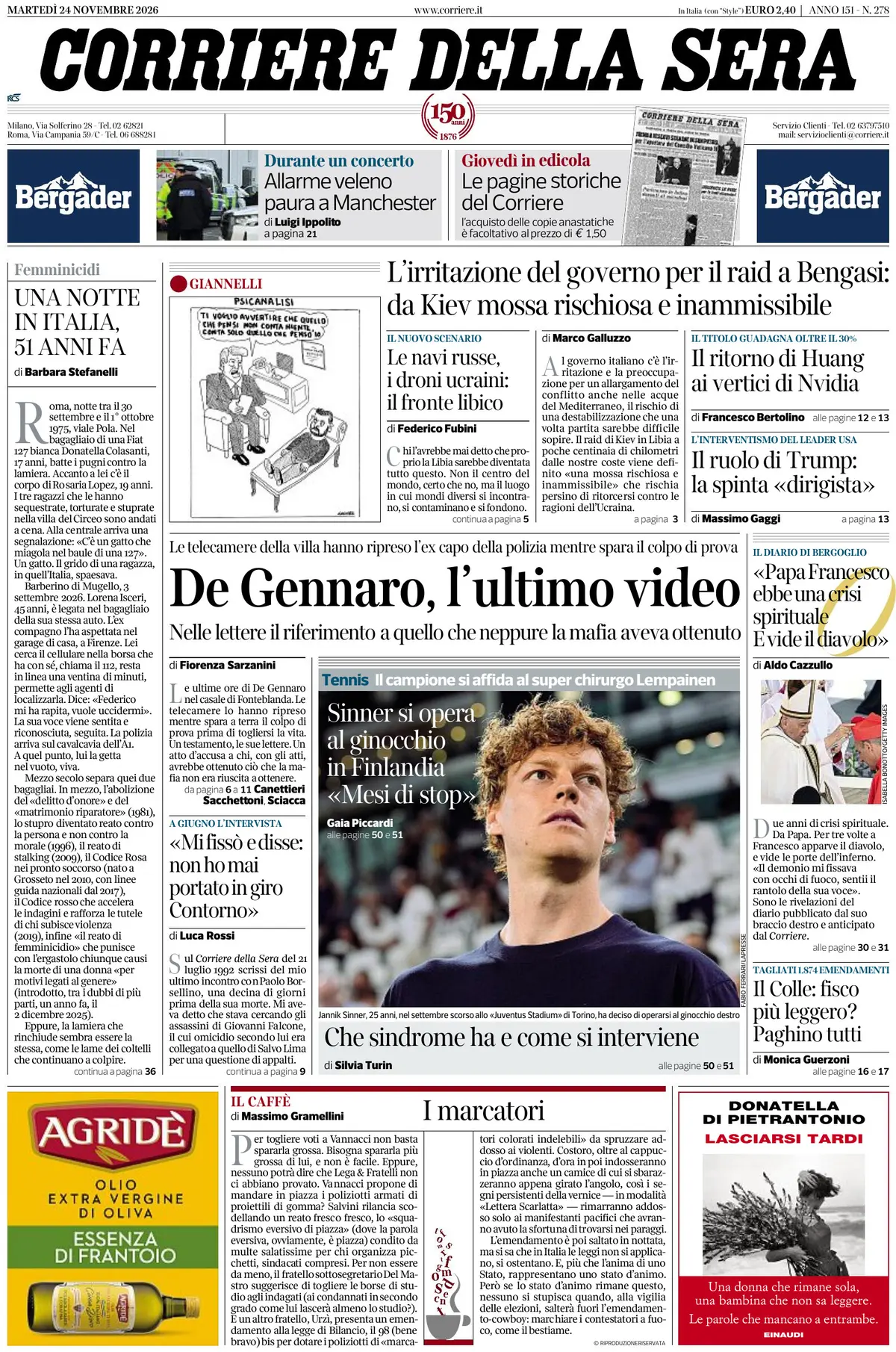
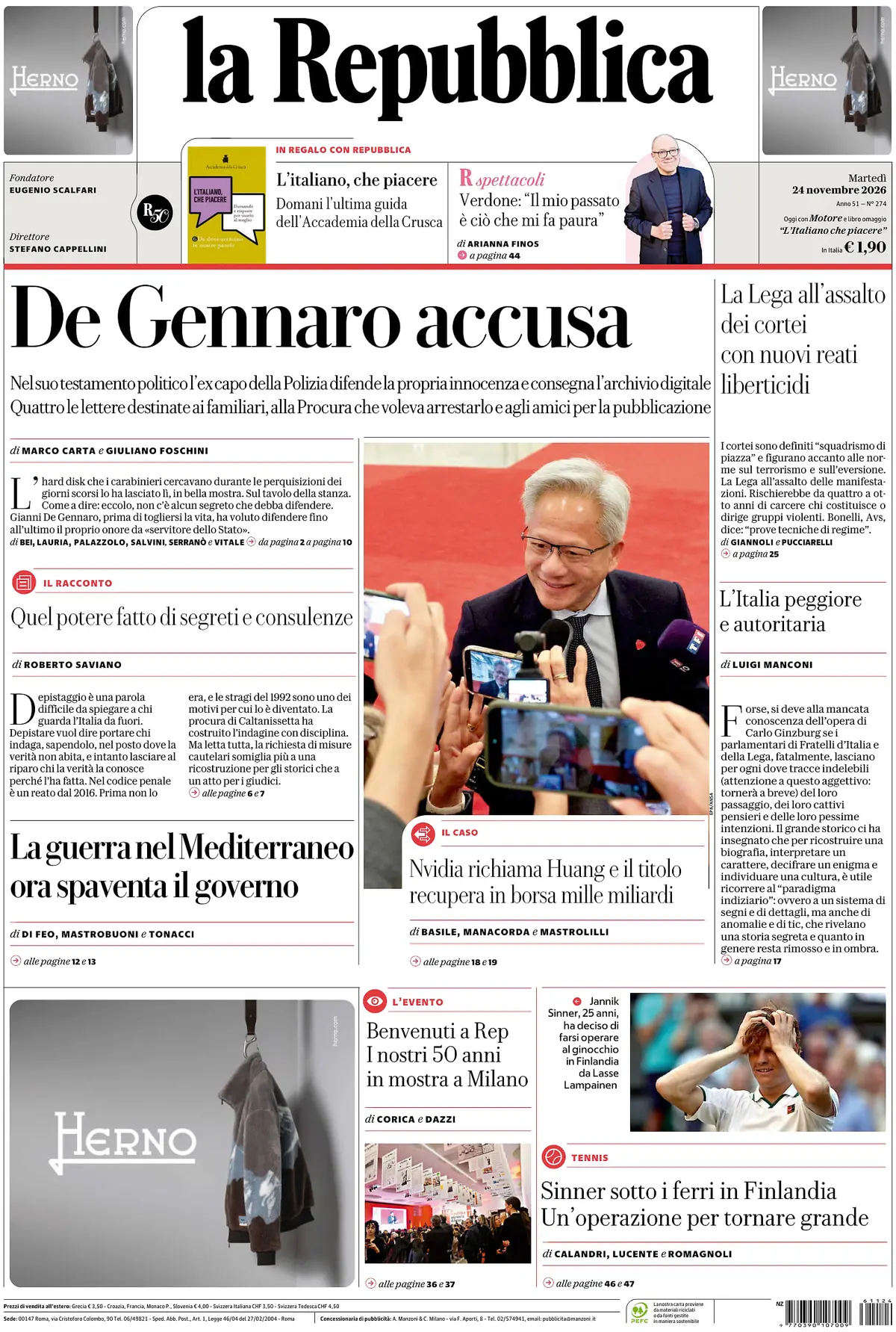
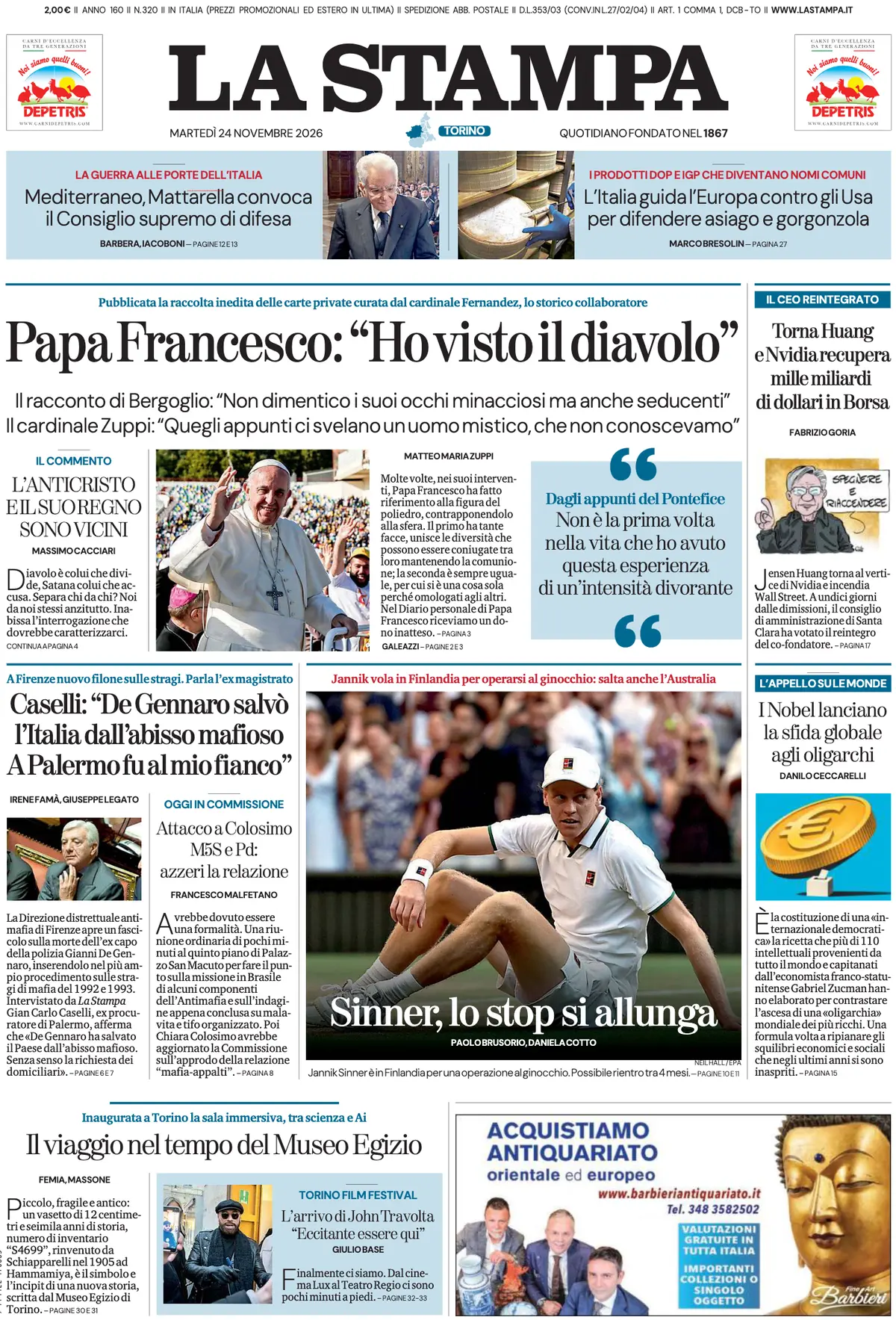
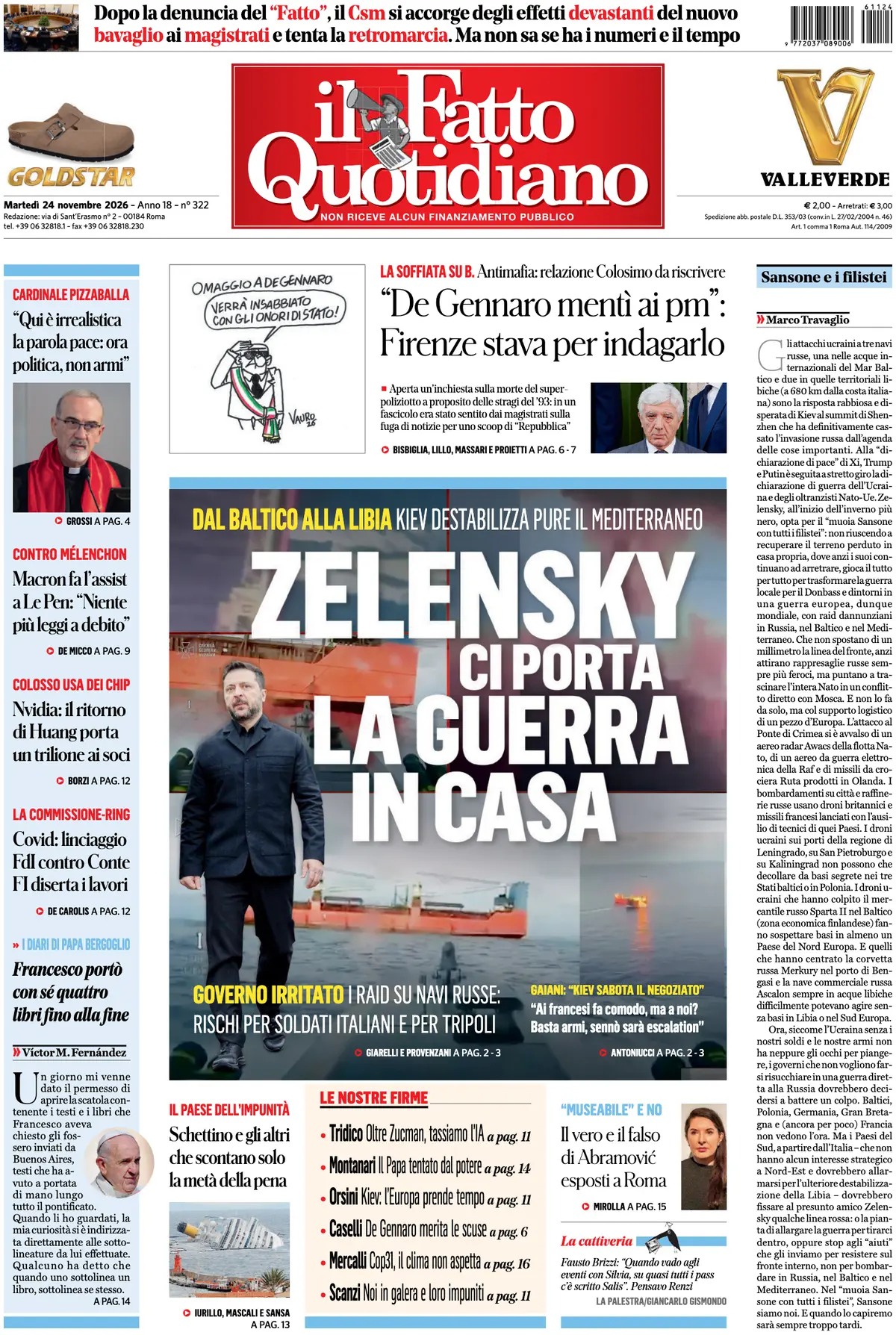
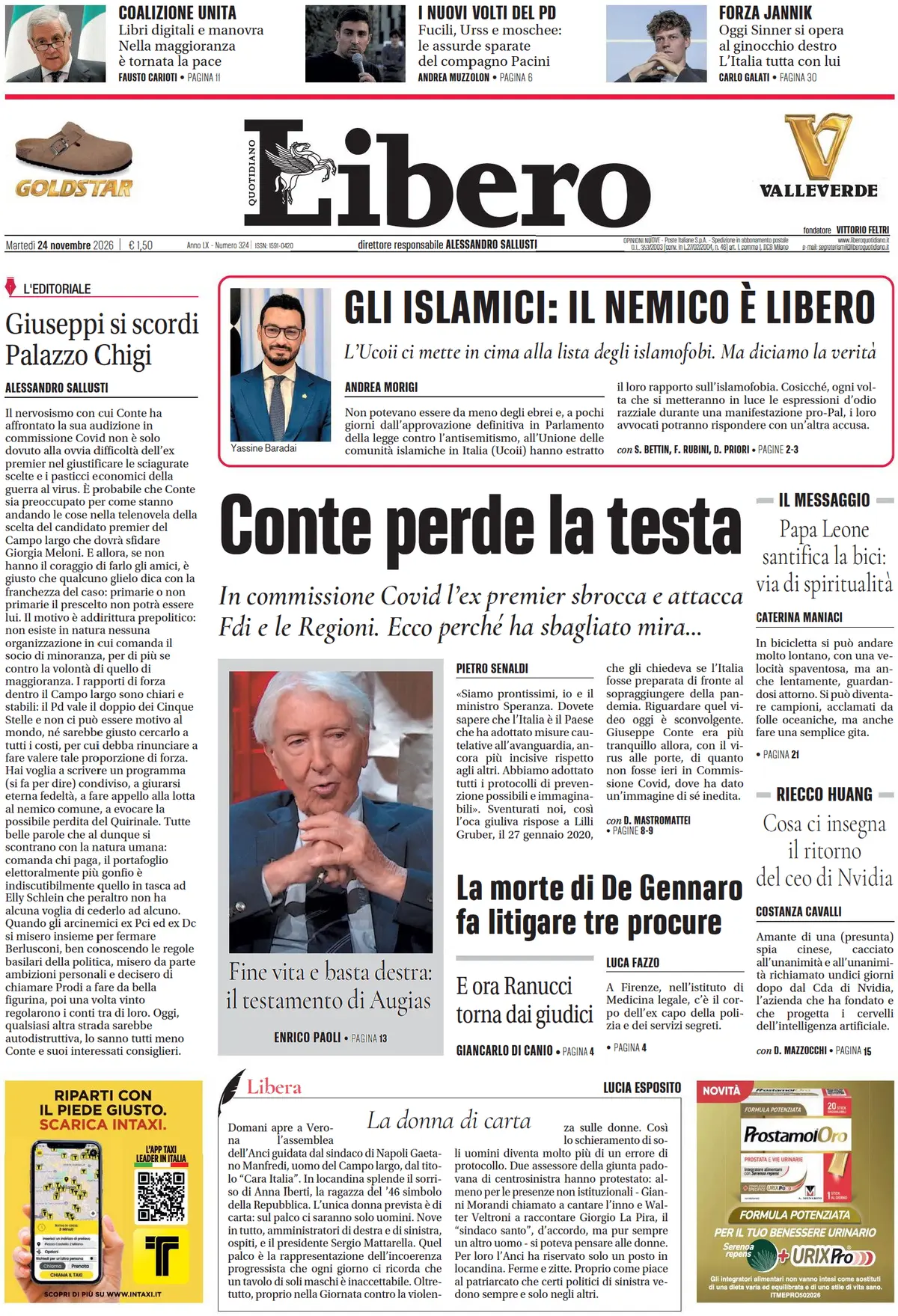
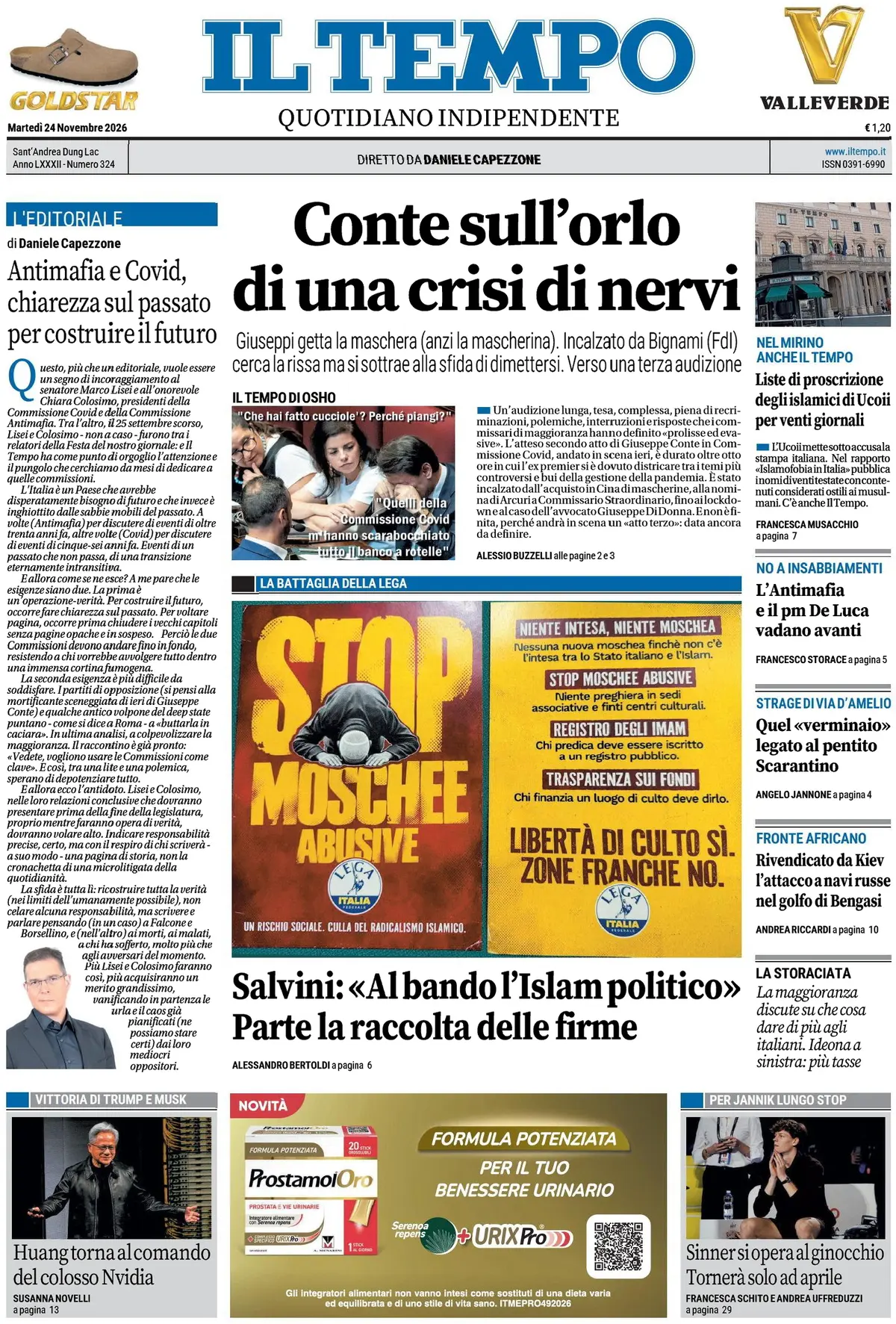
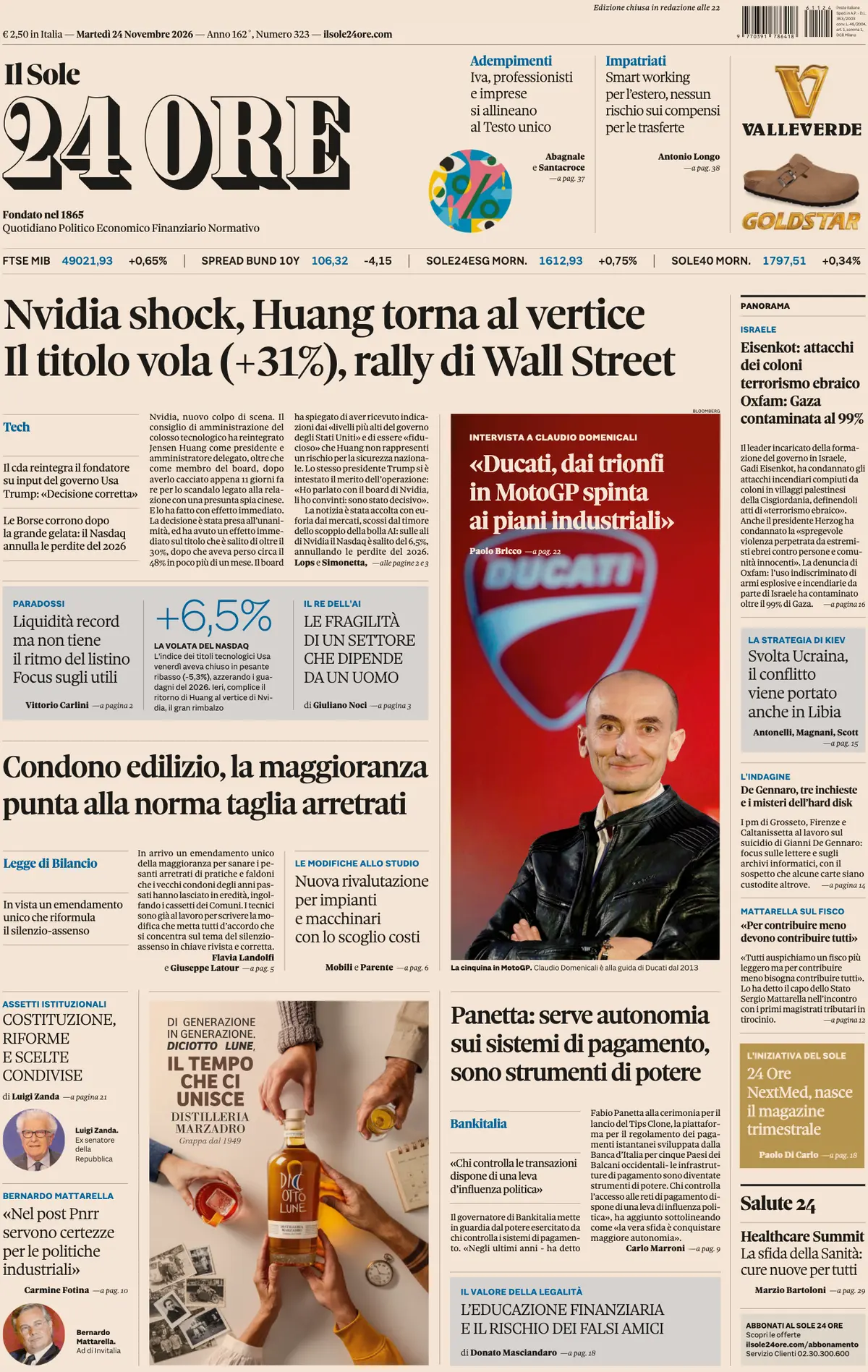
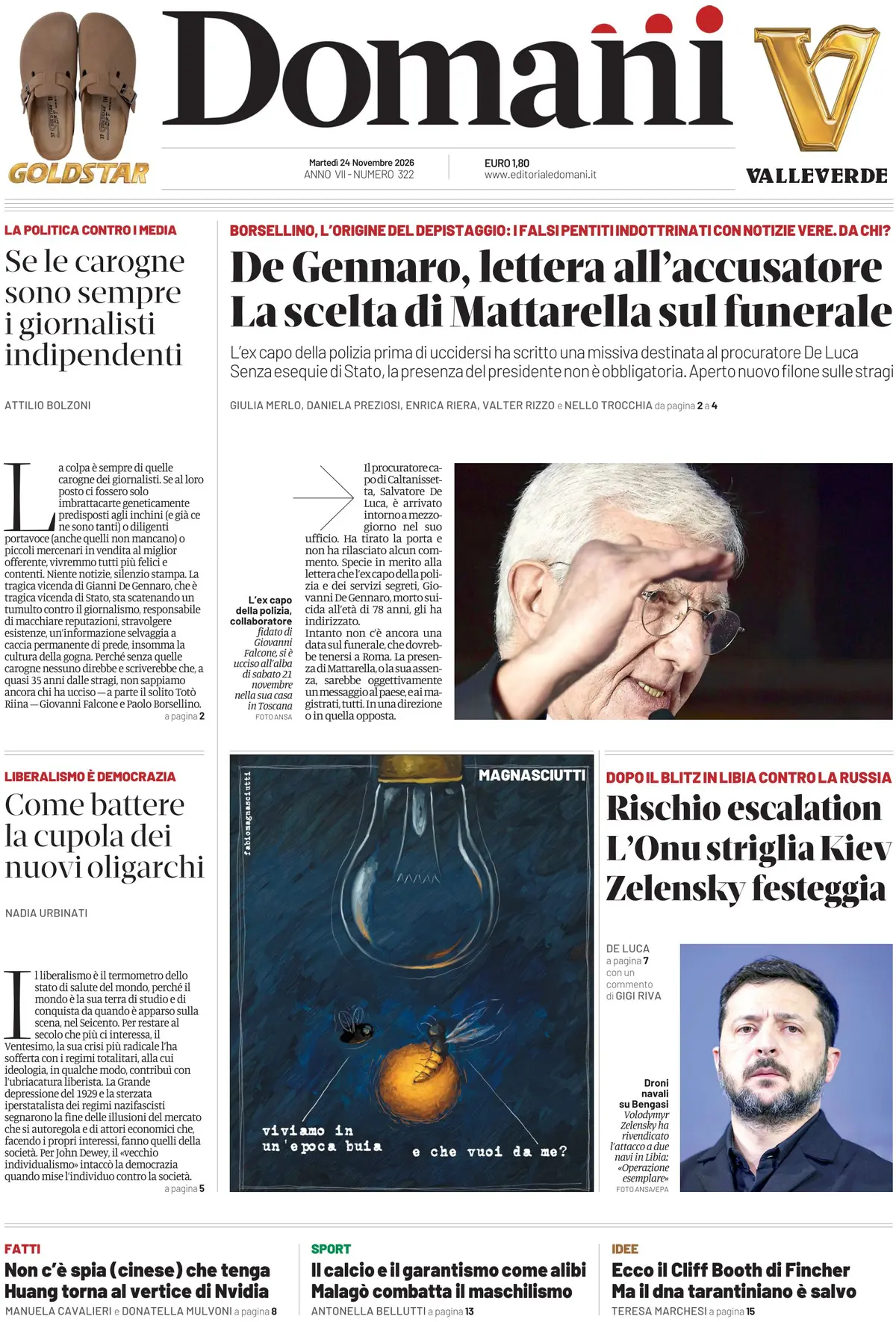
Front pages, 24 November: the Mediterranean, De Gennaro’s documents and Huang’s return
The war in the Mediterranean and the De Gennaro case compete for the main headlines in Italy’s newspapers on Tuesday, 24 November. The first brings the Russia–Ukraine conflict to waters off Libya and raises questions about Italy’s role. The second renews arguments over investigations, letters left by the former police chief and the legacy of the mafia bombings. Yet there is no single news hierarchy: Jensen Huang’s return to the helm of Nvidia leads the business daily, while Avvenire places dignity and social responsibility at the centre of its coverage.
## The Mediterranean moves to the front
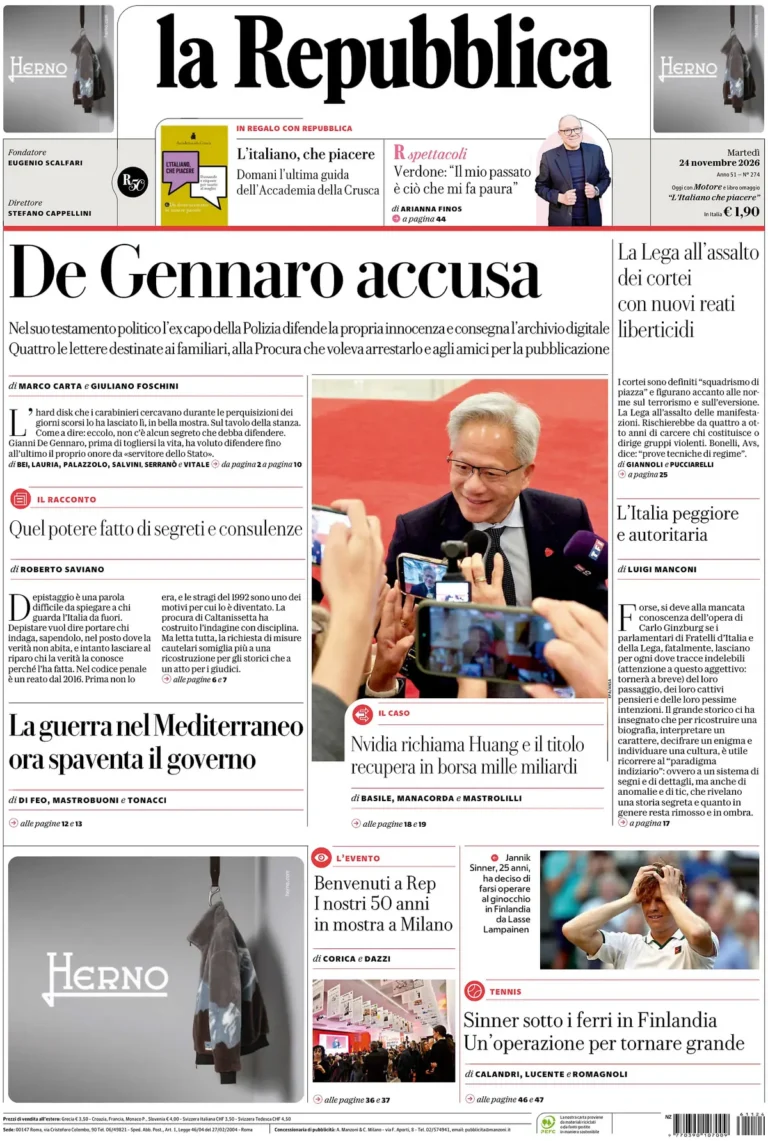
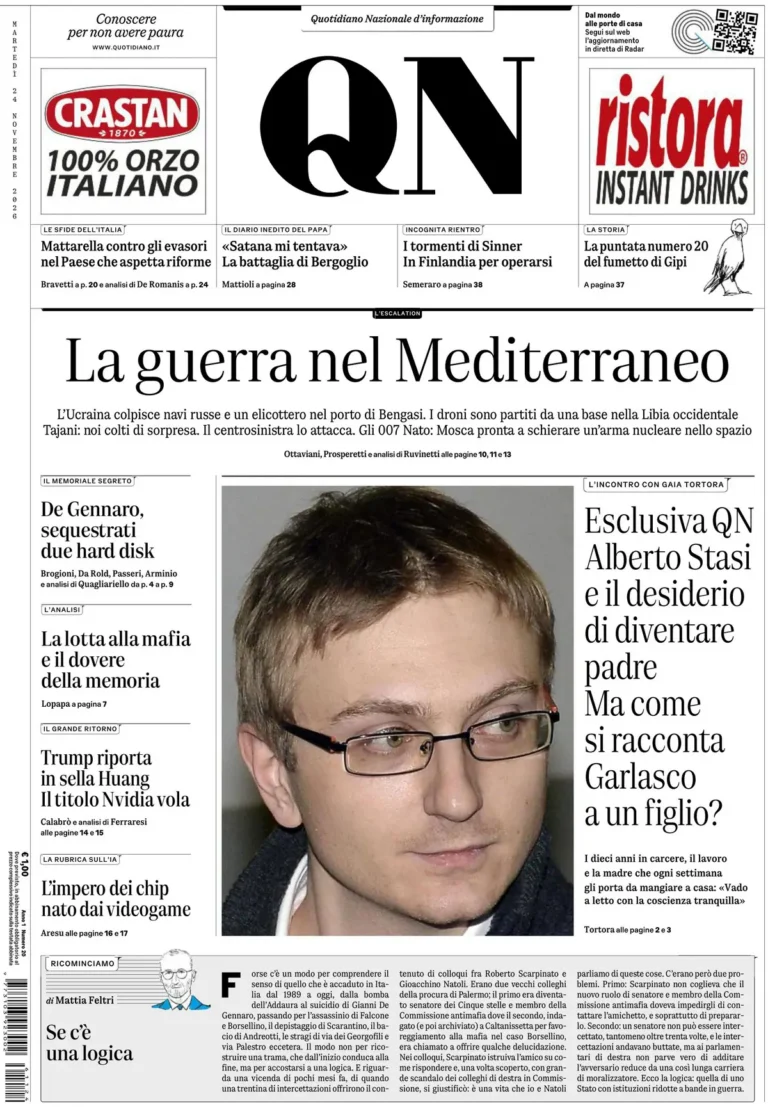
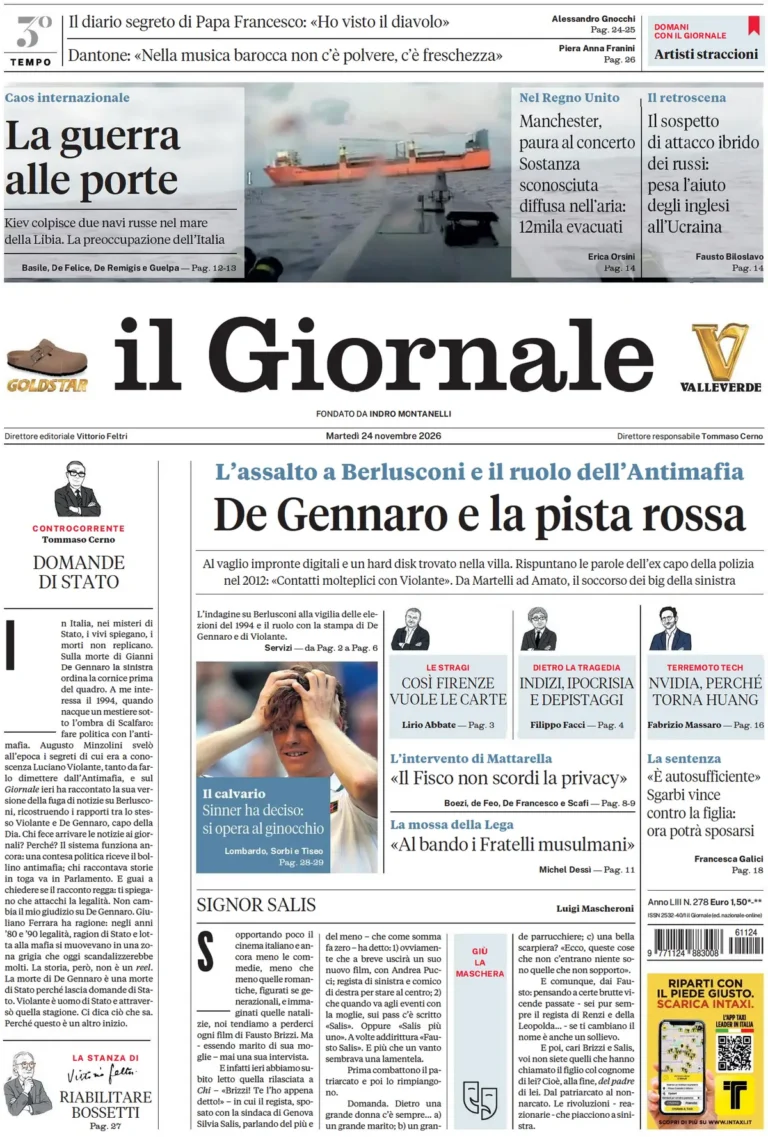
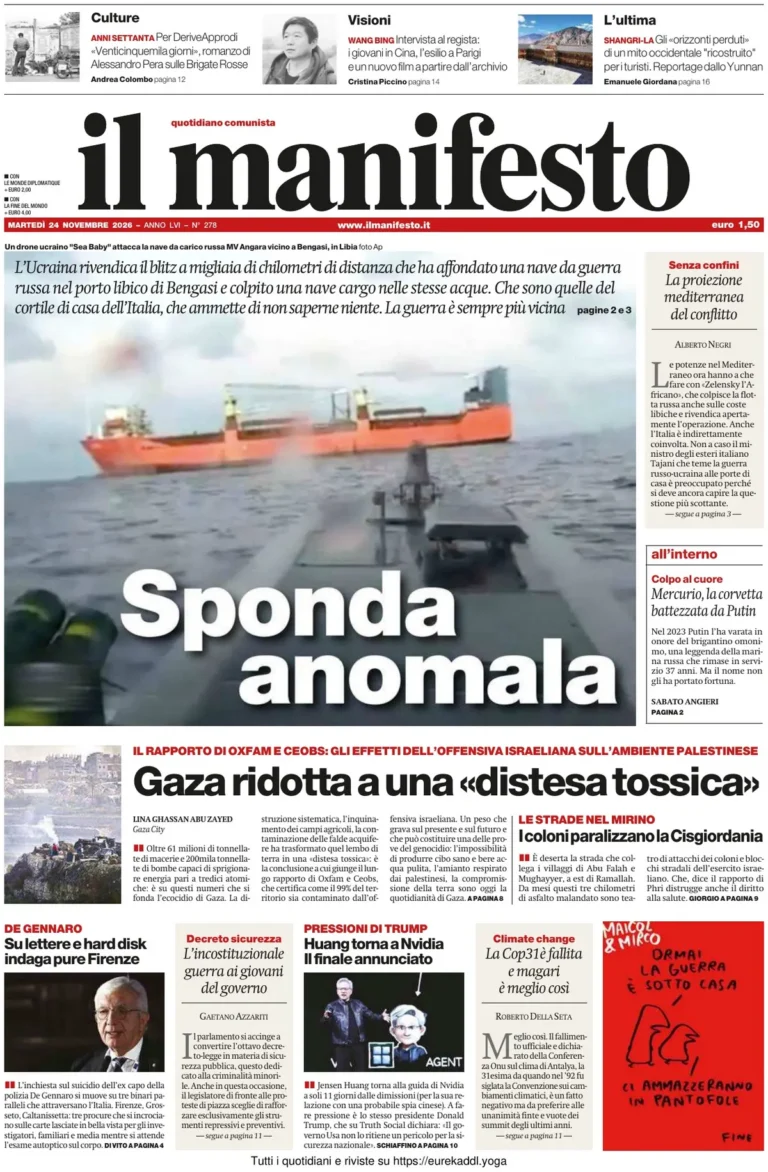
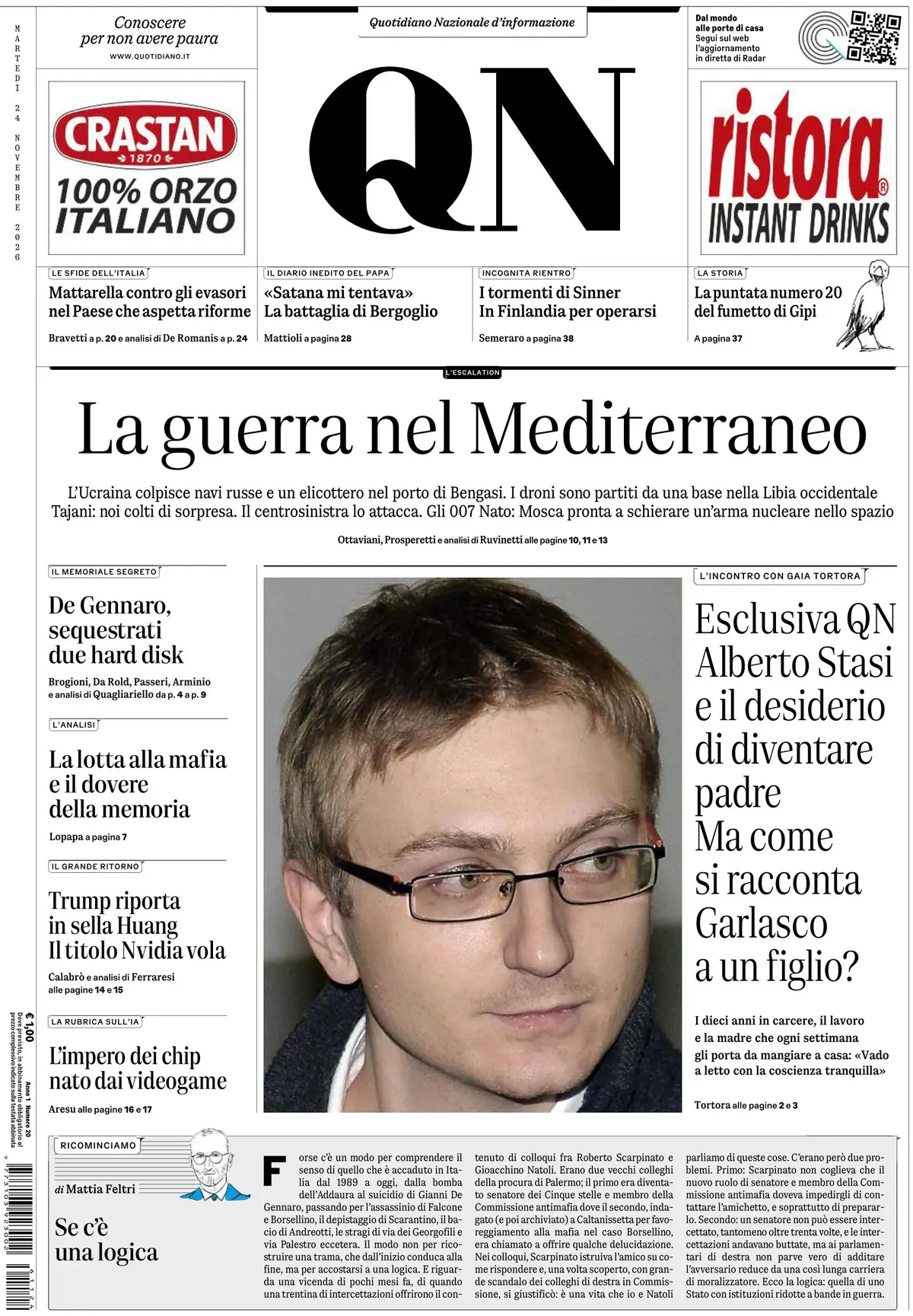
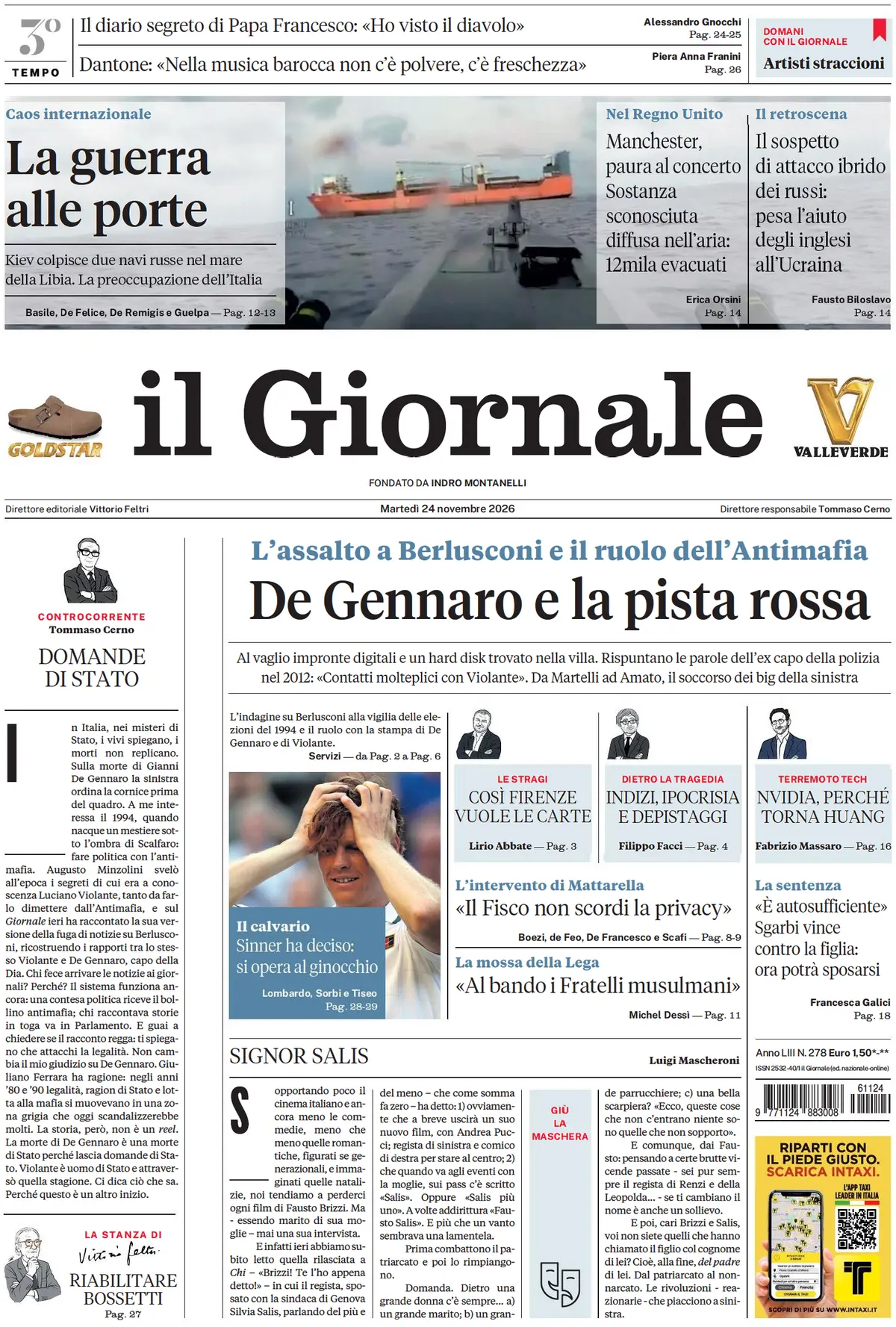
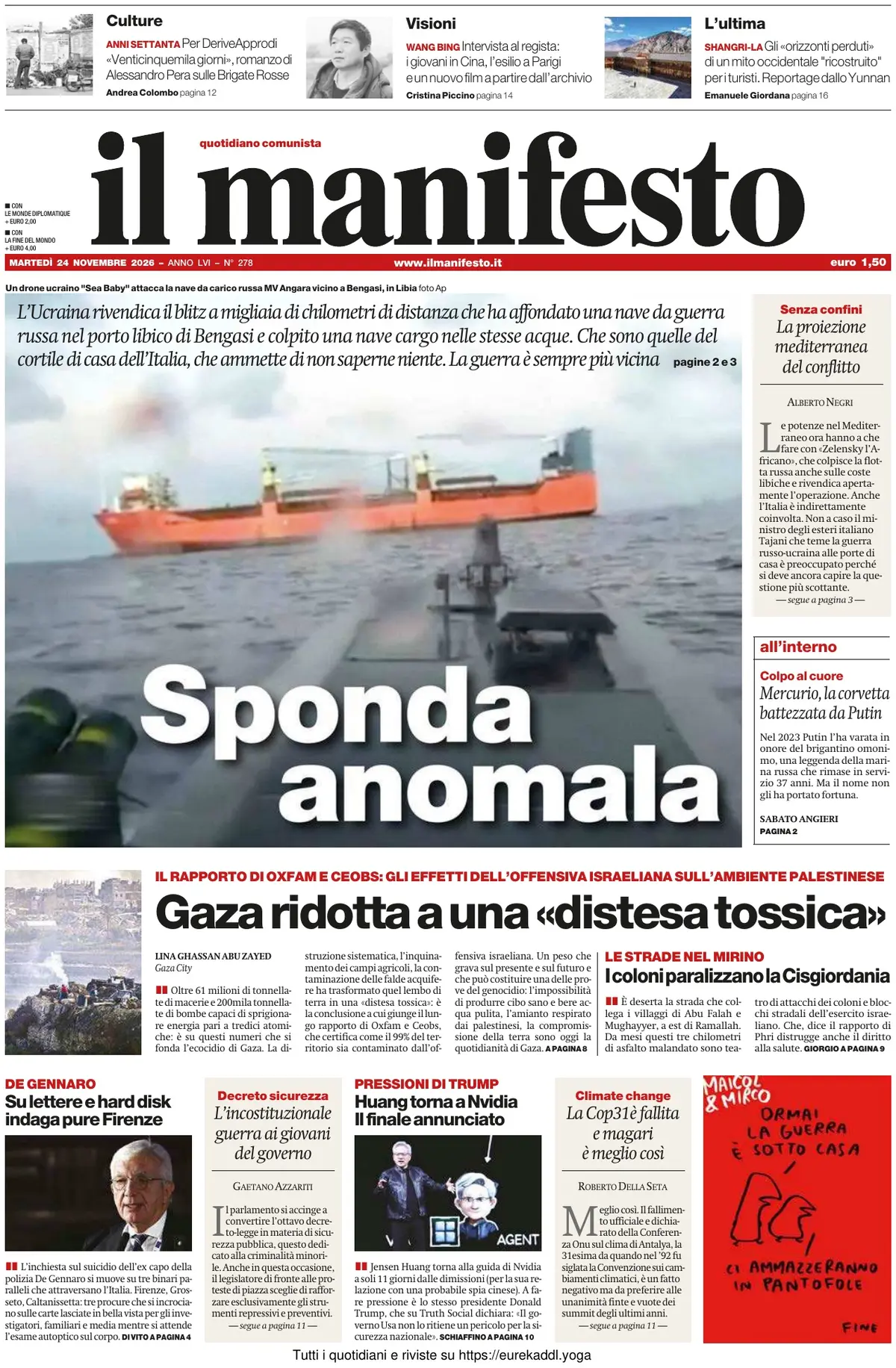
QN leads with war in the Mediterranean. Il Giornale places a warning about war at the doorstep above its masthead, while Repubblica highlights the government’s concern. Il manifesto builds its front page around a photograph of a ship and a headline suggesting an unexpected shore, shifting attention towards Libya and the alliances running through the region.
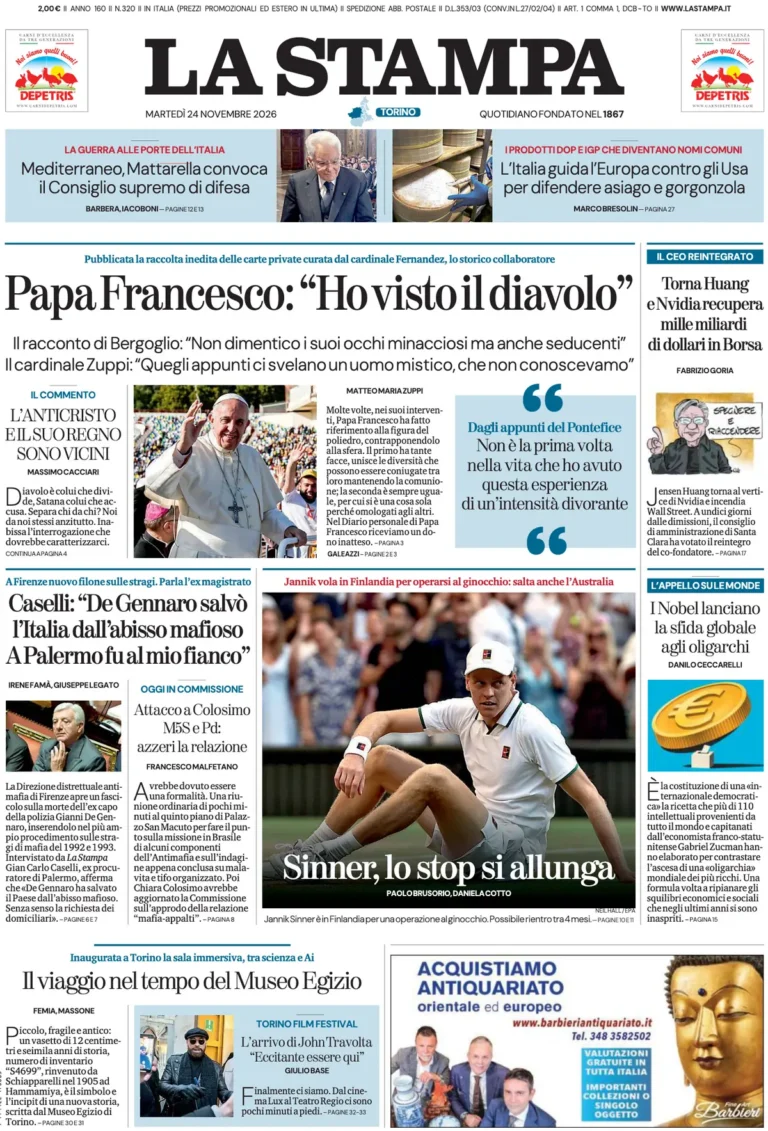
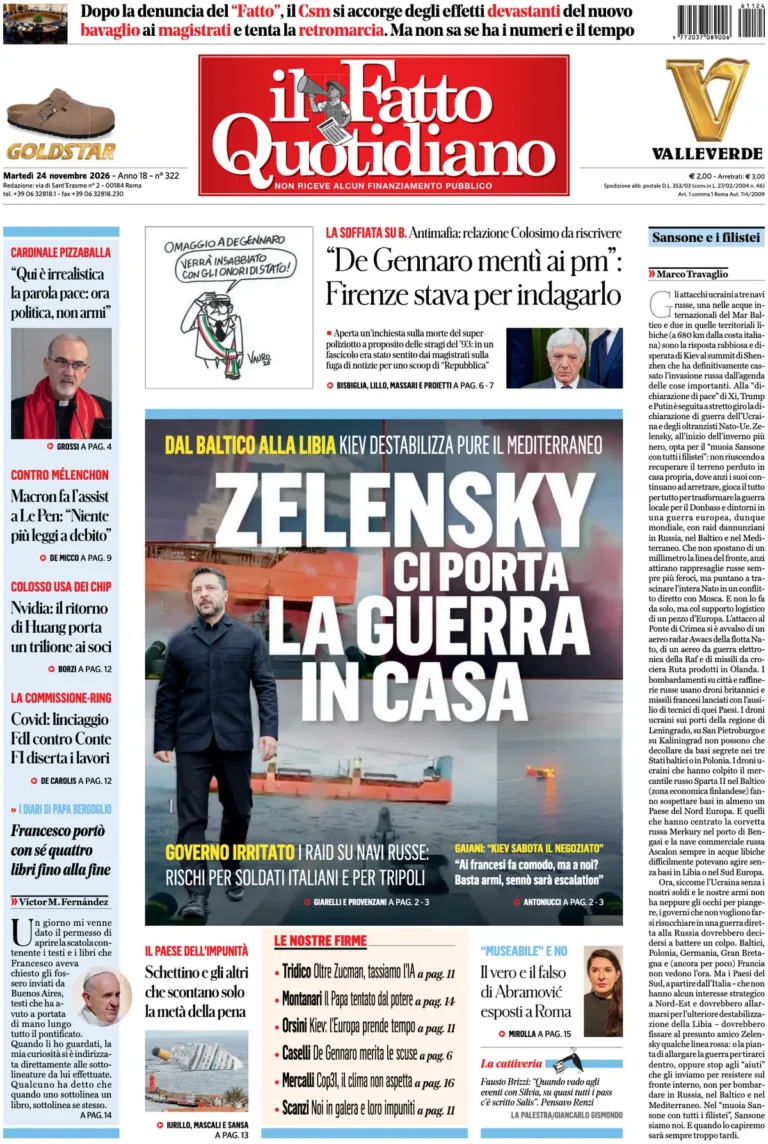
Il Fatto Quotidiano takes an explicitly critical stance, blaming Zelensky for bringing the conflict closer to Italy. That is the newspaper’s political judgement, distinct from the news of the attack claimed by Kyiv. La Stampa emphasises the institutional response, highlighting Mattarella’s decision to convene the Supreme Defence Council. Across these different treatments, the common question is how a war associated with eastern Europe is affecting Mediterranean security.
## De Gennaro: documents and competing interpretations
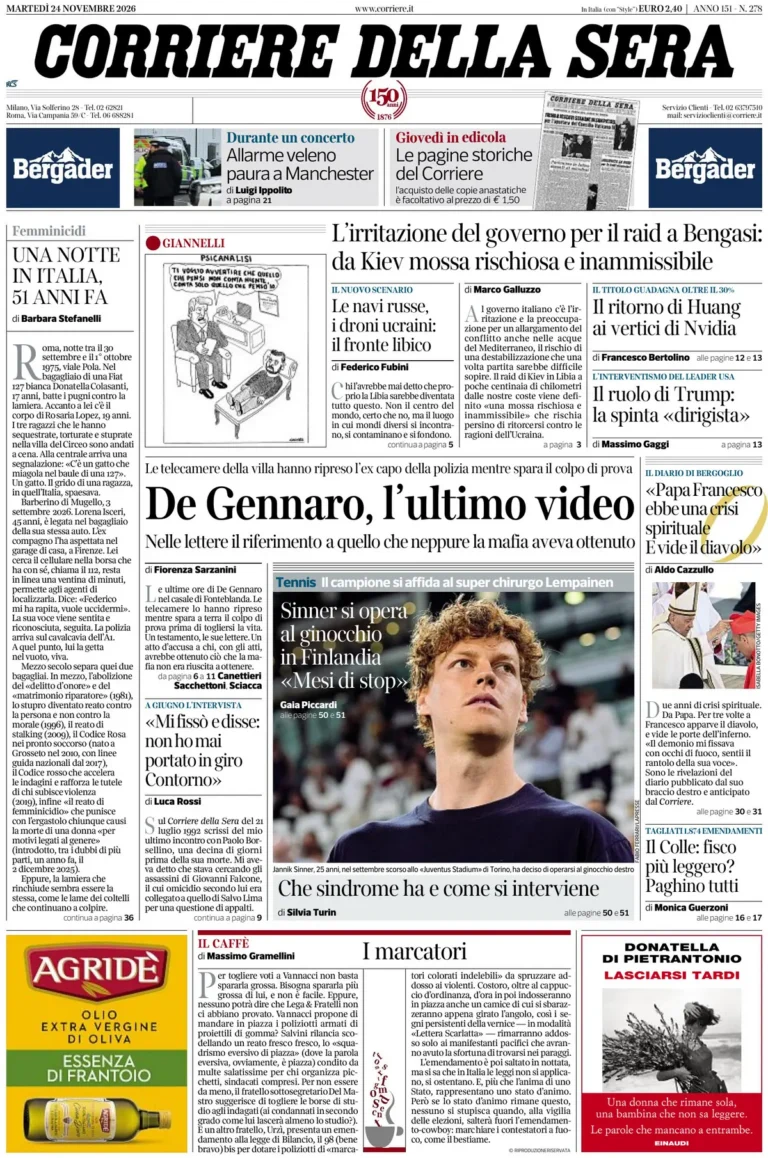
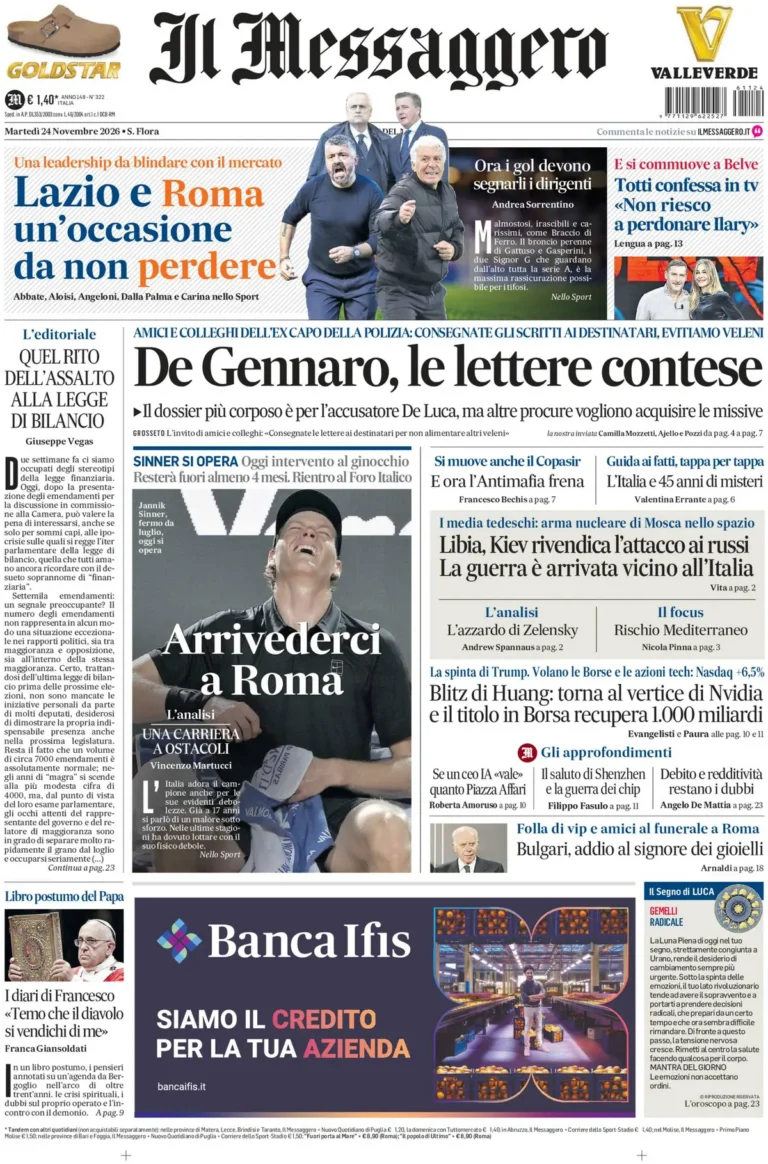
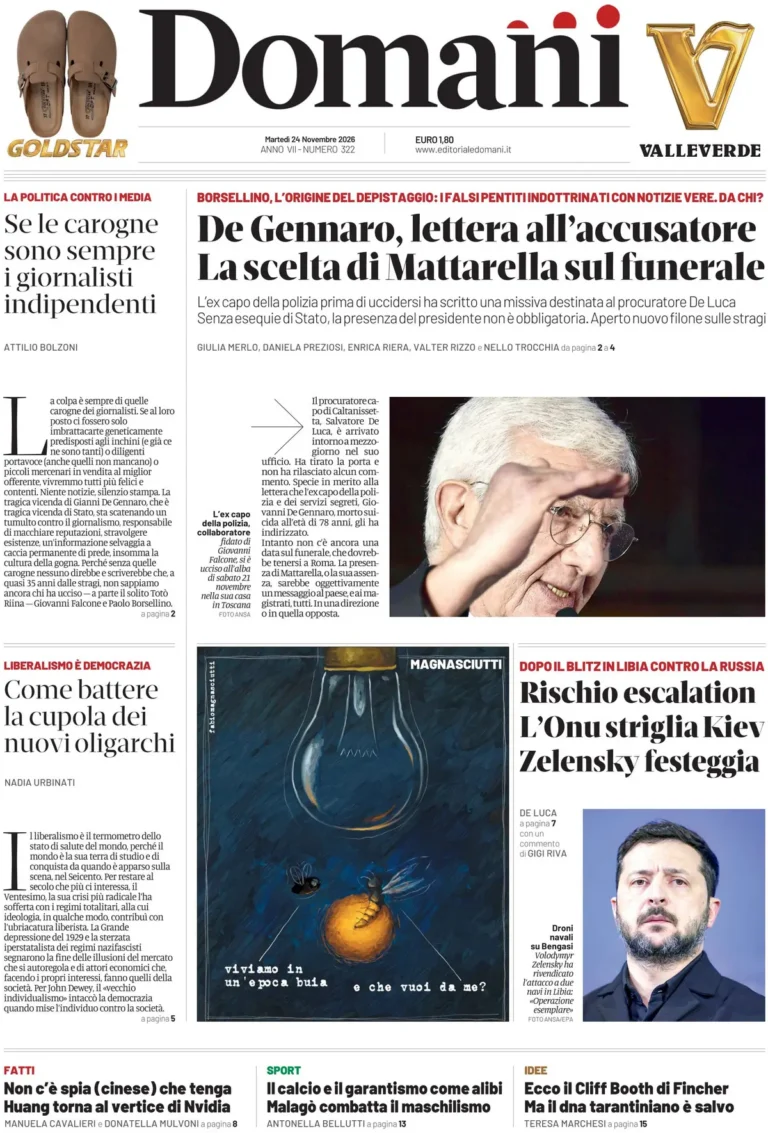
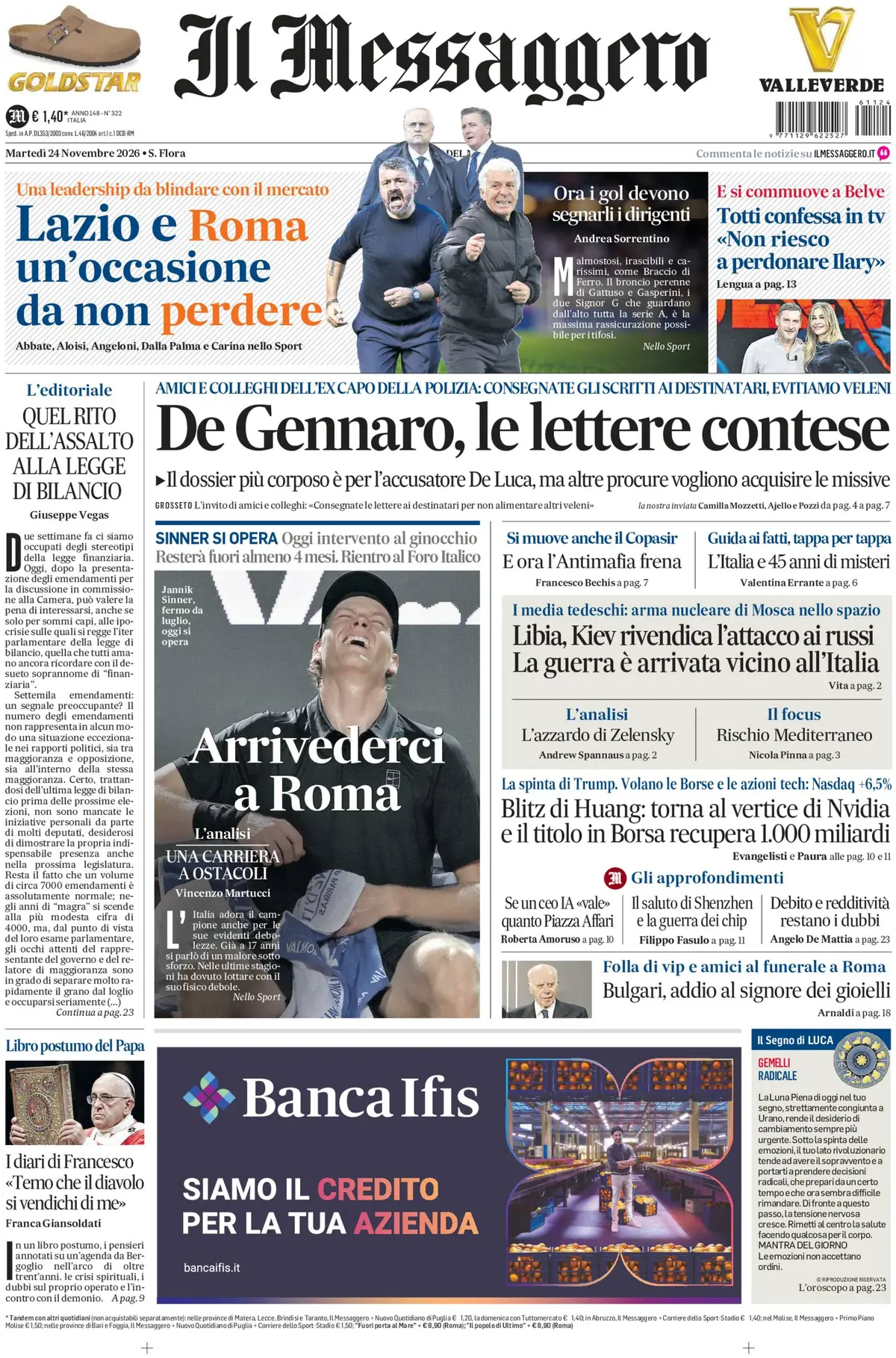
Corriere della Sera focuses on De Gennaro’s final video; Repubblica leads on his accusations. Il Messaggero highlights the dispute over his letters, while Domani pairs the letter to his accuser with Mattarella’s silence. These are different approaches to the same case: documents, recipients and institutional consequences now occupy space previously dominated by the news of his death.
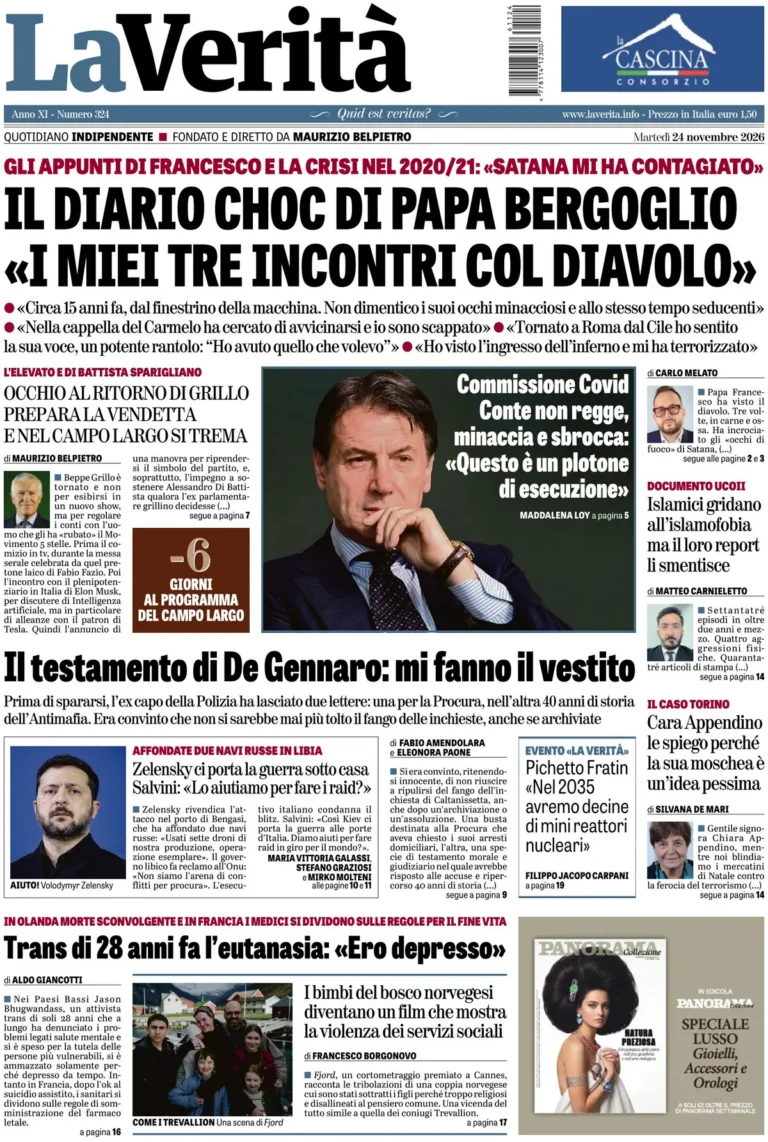
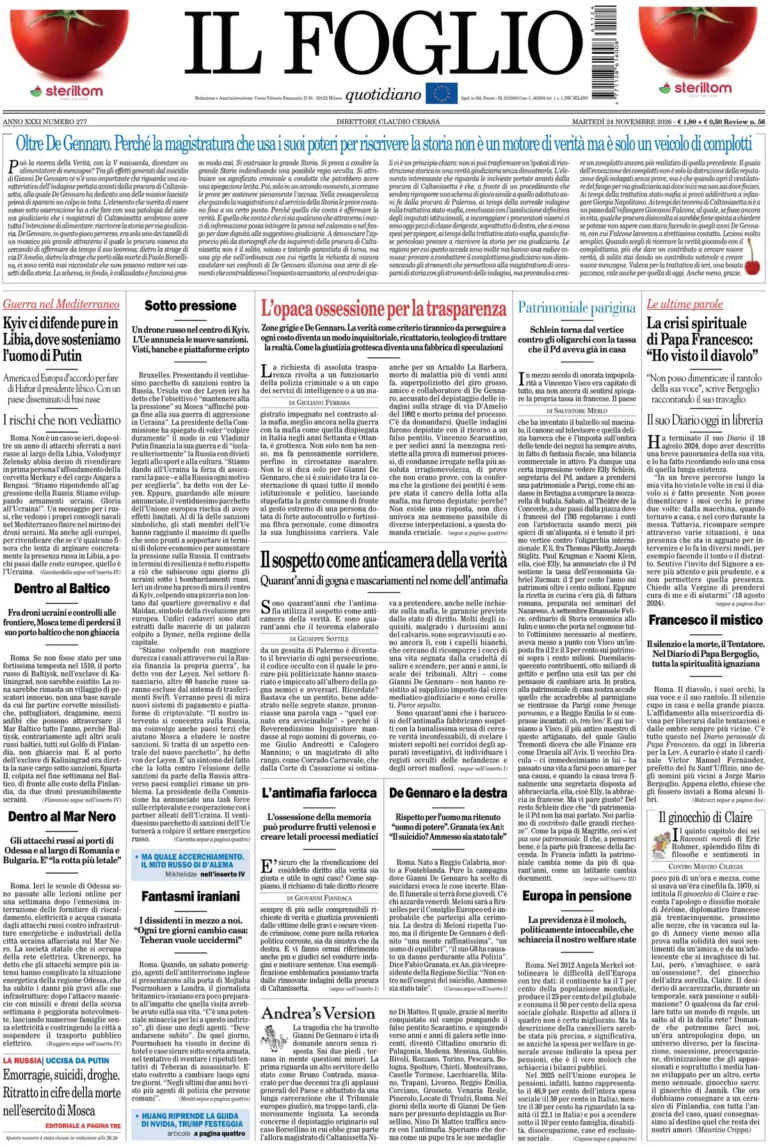
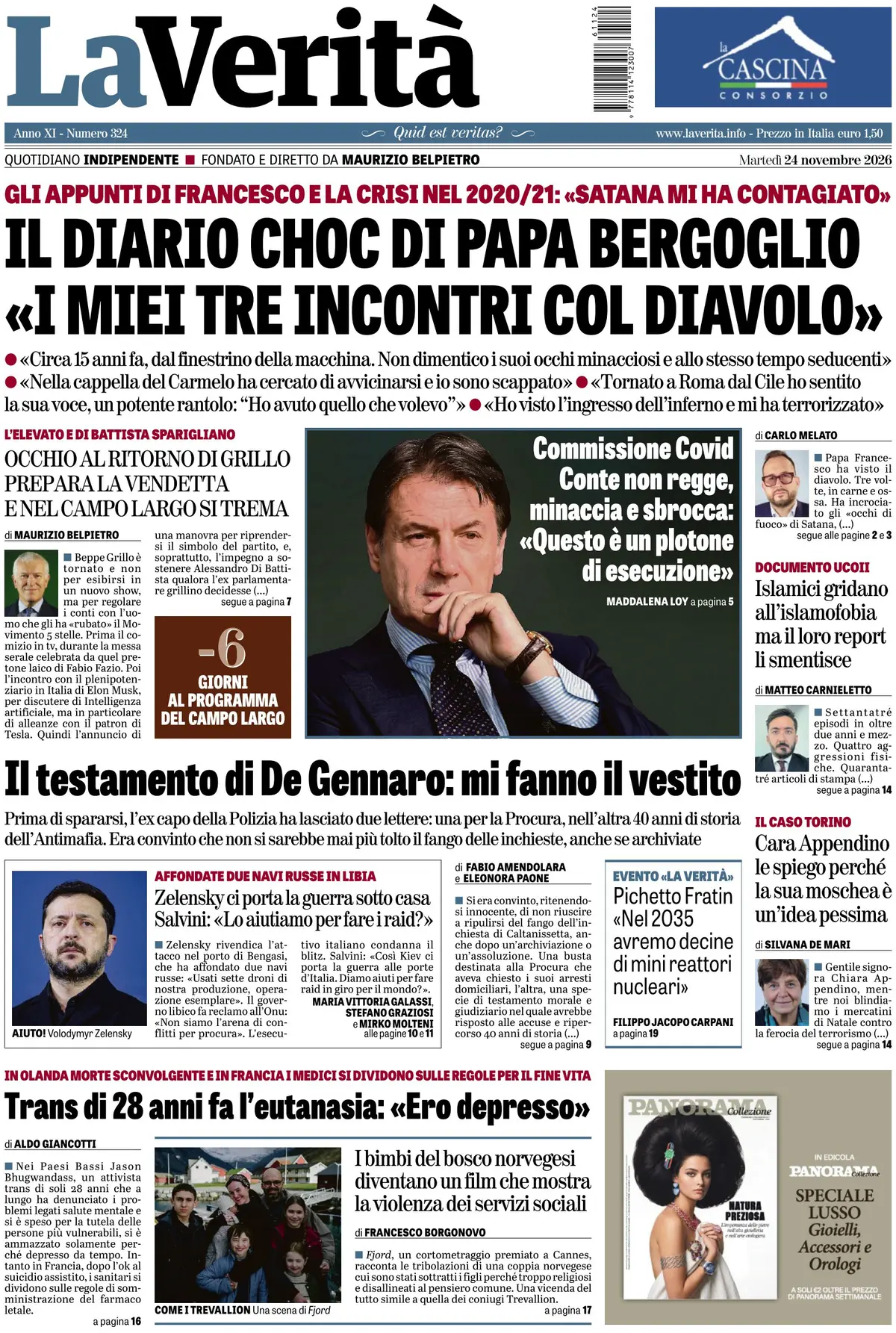
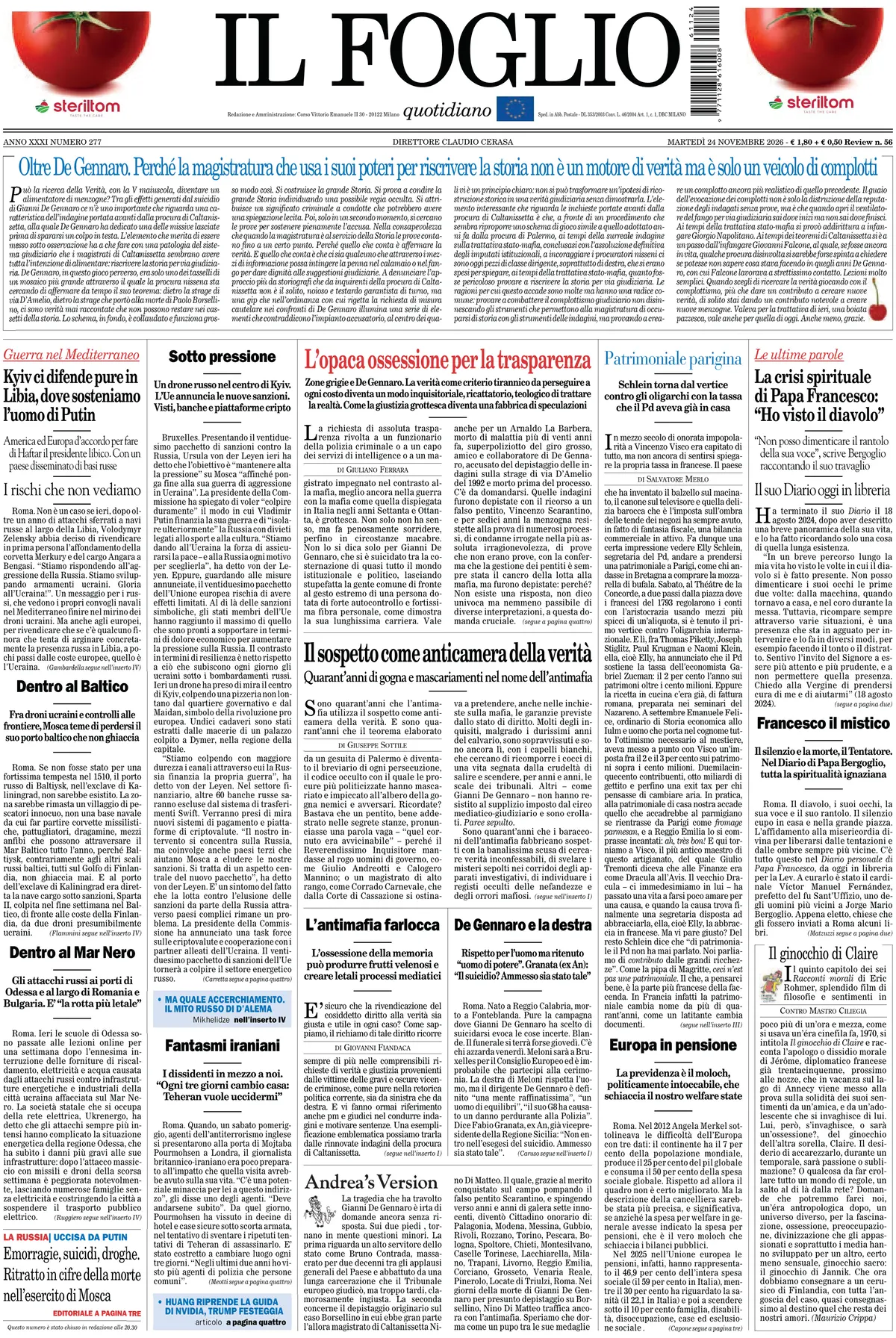
Il Giornale foregrounds a supposed left-wing line of inquiry, linking its account to the Anti-Mafia Commission and the cases concerning Berlusconi. La Verità stresses his testament and his wishes concerning how he should be remembered. Il Foglio uses its upper section for a reflection on the judiciary, institutional powers and the reconstruction of history. The language of the headlines shows how much of this debate concerns interpretation: allegations, hypotheses and editorial judgements are not judicial findings.
## Conte and domestic politics
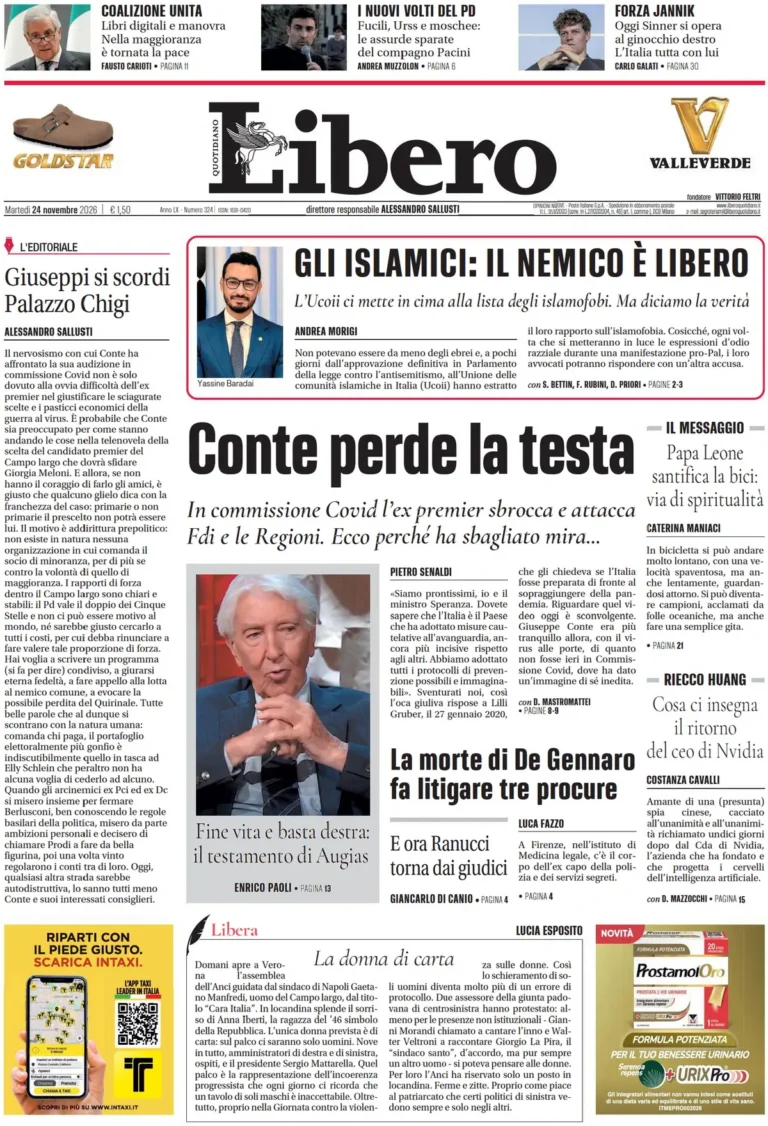
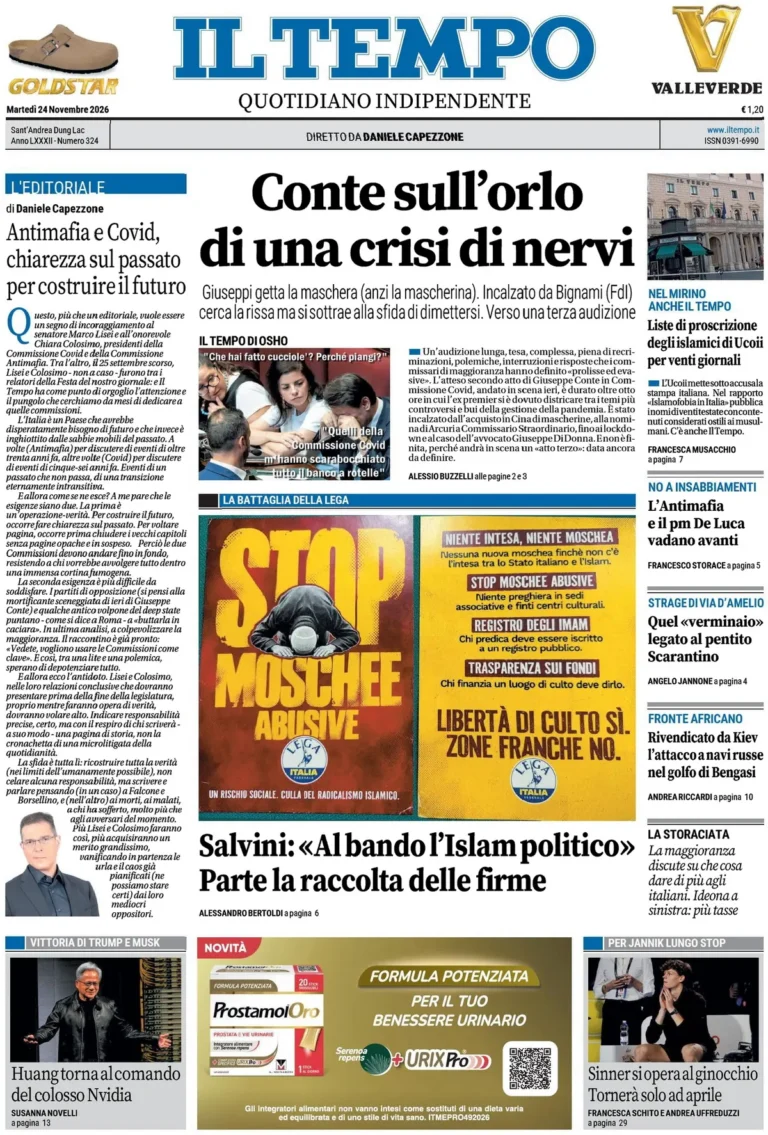
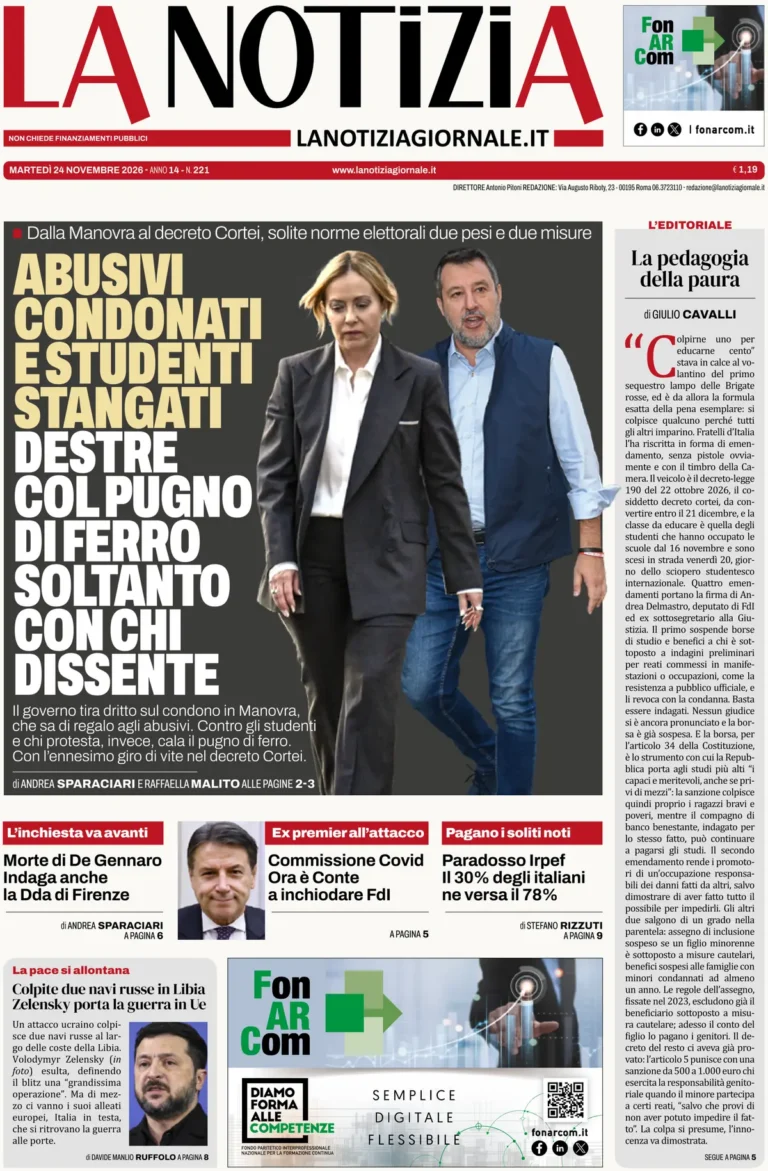
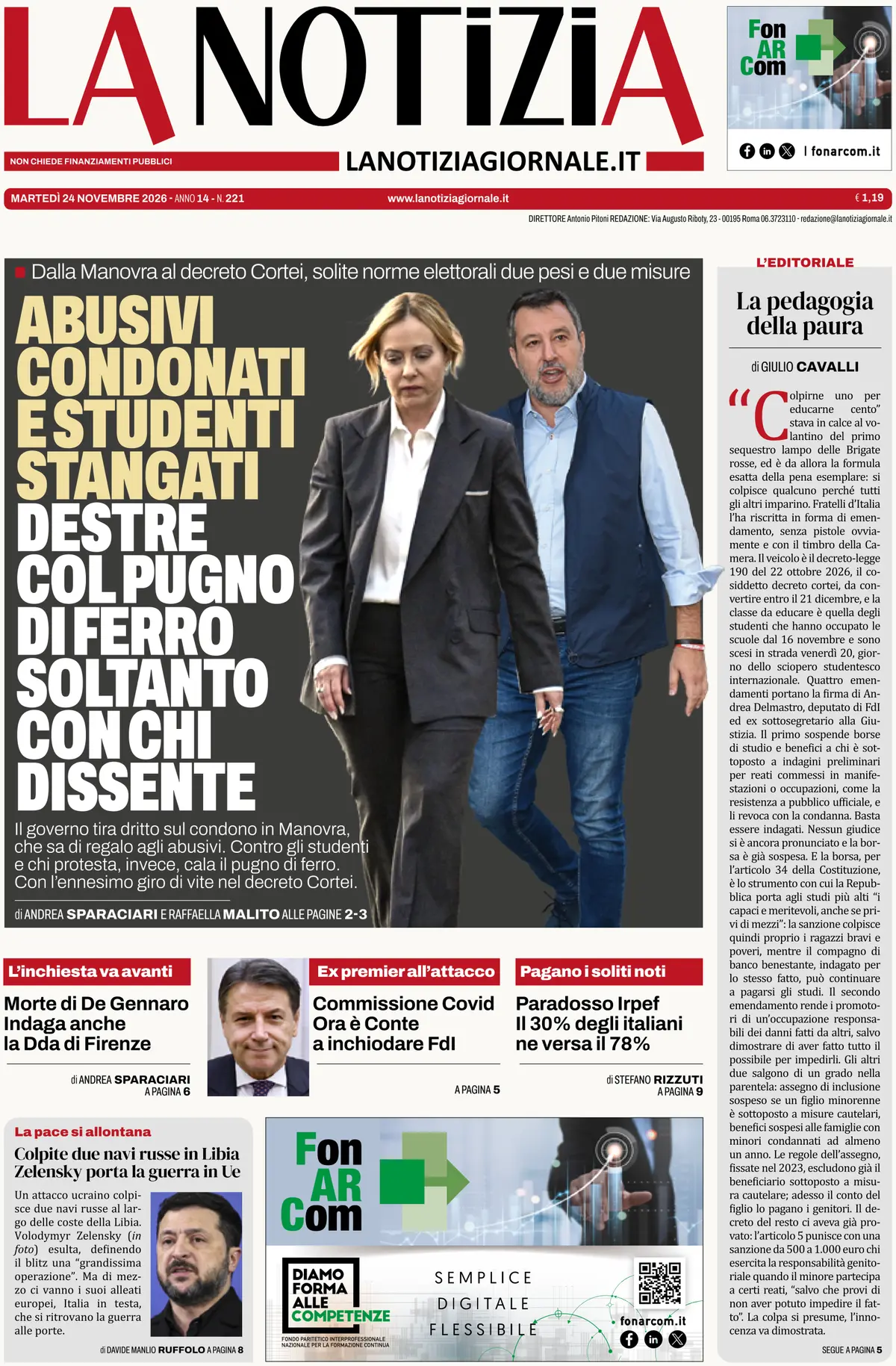
Libero devotes its main headline to Conte, portraying him as a leader under pressure. Il Tempo leads on the clash surrounding the Covid inquiry commission, taking a sharply critical view of the former prime minister. La Notizia chooses a different target, contrasting proposed treatment of building violations with measures against protesters and accusing the government of double standards.
The contrast captures the day’s polarisation. Depending on the newspaper, domestic political coverage becomes an indictment of either the opposition or the governing majority. Recognising those perspectives does not turn them into a single agreed account.
## Technology, taxation and dignity
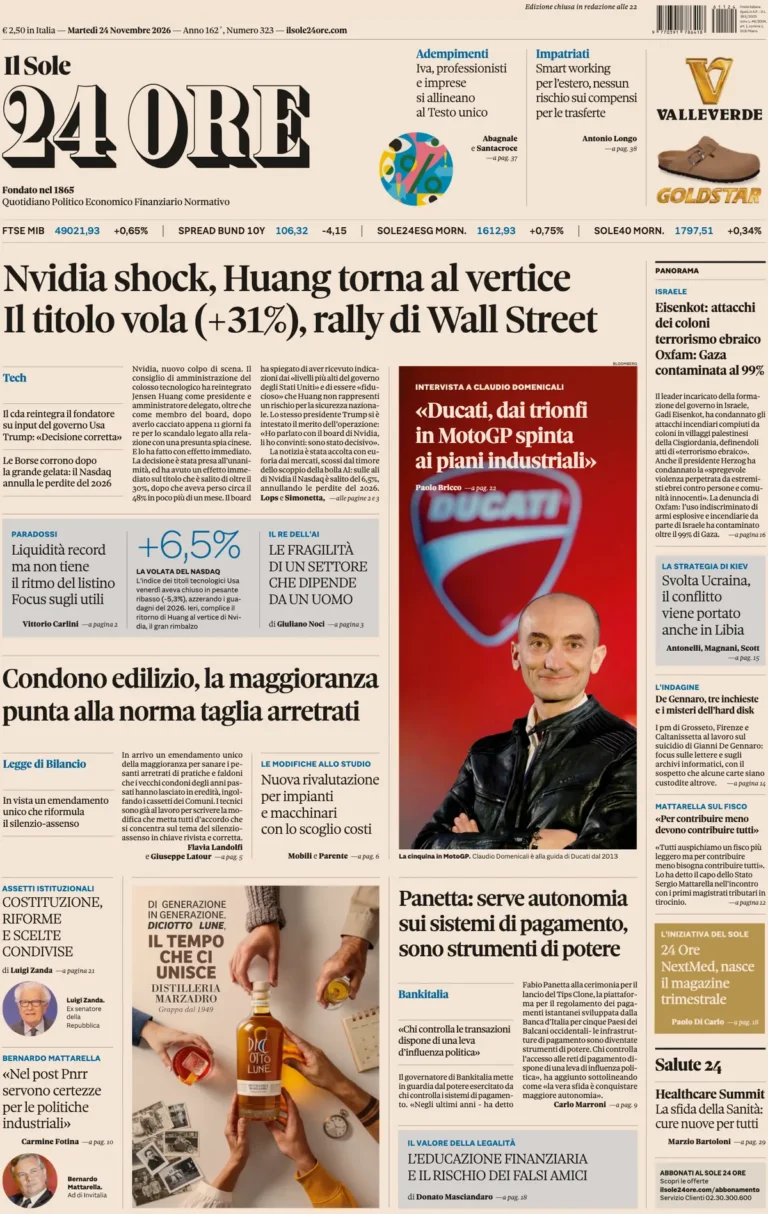
Il Sole 24 Ore leads on Huang’s return to Nvidia and Wall Street’s response. Its front page connects corporate governance, artificial intelligence and financial markets, while also covering the debate over a building amnesty and tax compliance. The market figure in the headline belongs to the trading session reported by the newspaper, not to a real-time quotation.
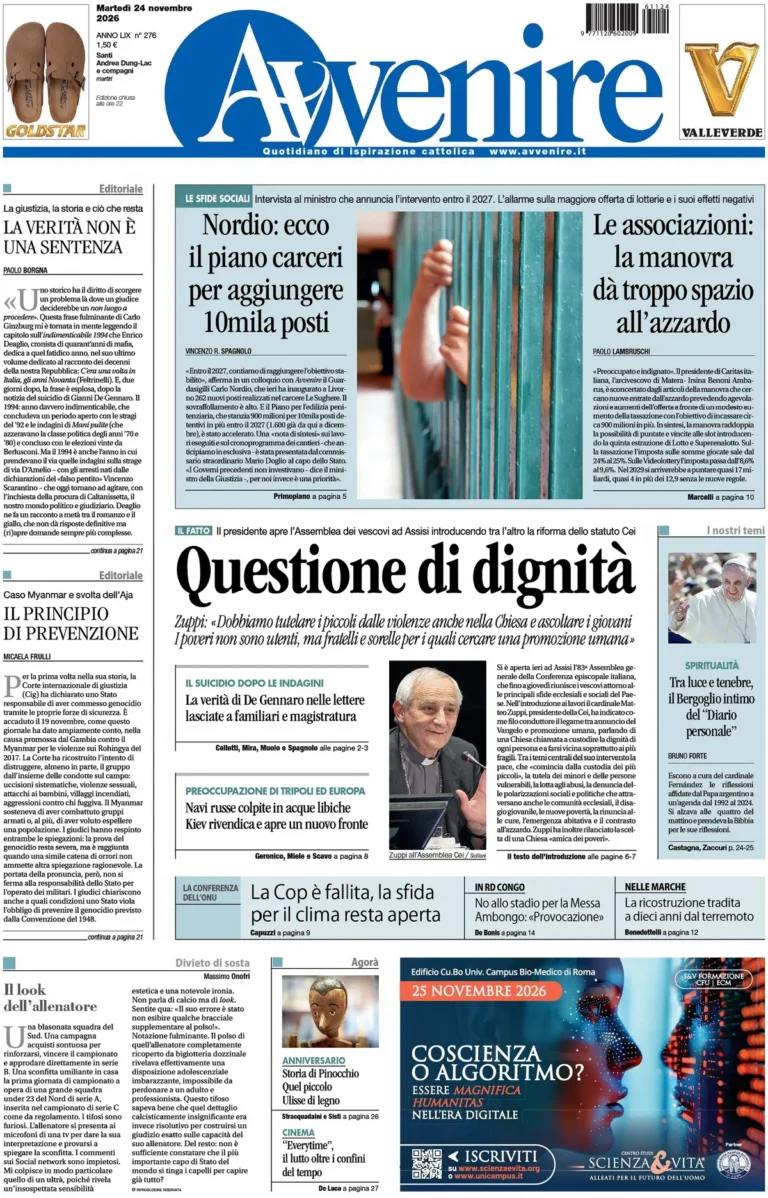
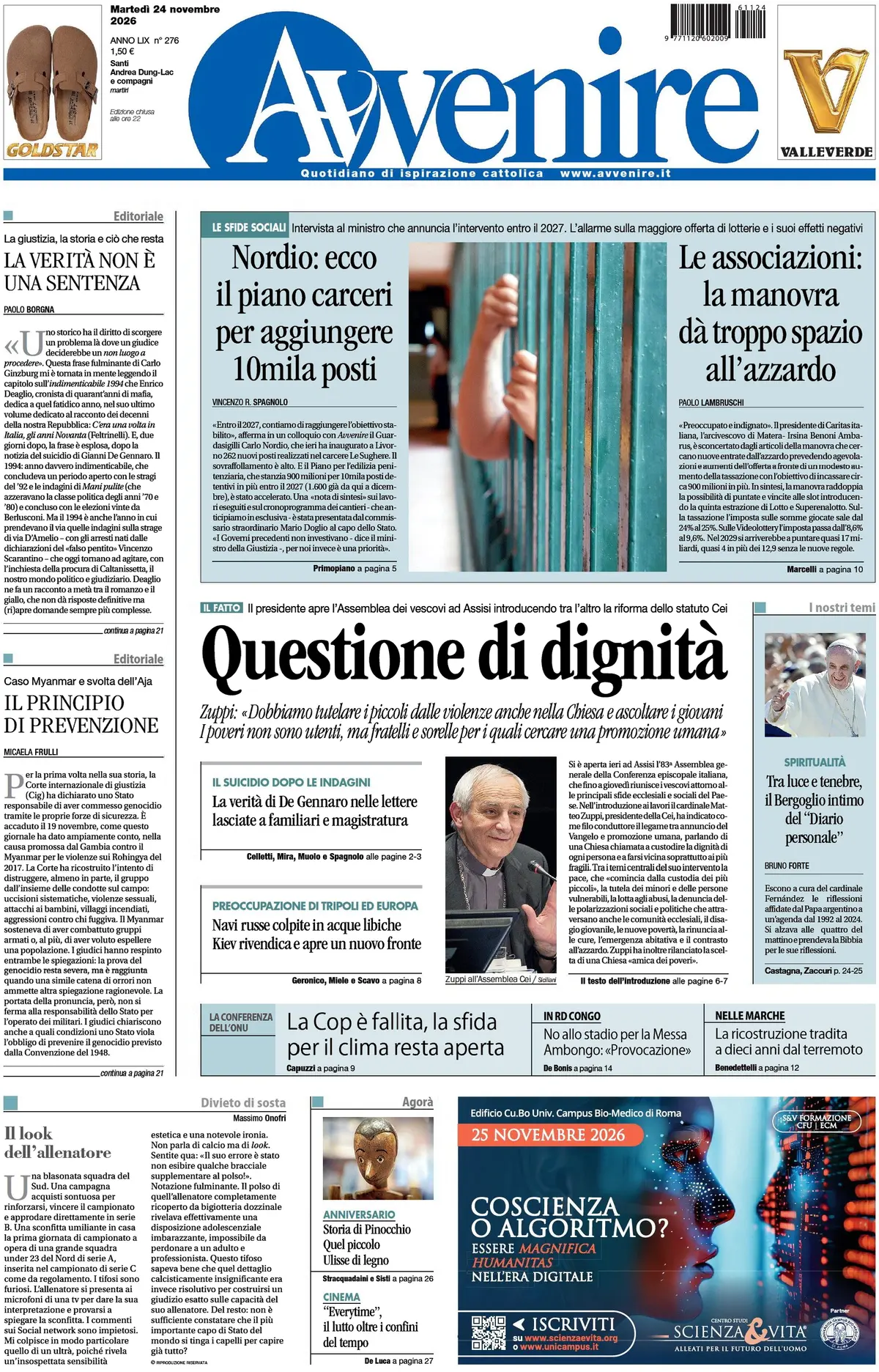
Avvenire leads on dignity, placing the Italian bishops’ conference alongside prisons and gambling. Its interview with Justice Minister Nordio presents a plan to increase prison capacity; a separate item reports associations’ objections to budget measures expanding gambling. This agenda focuses on how public decisions affect vulnerable people.
## Francis’s diary and concern for Sinner
La Stampa and La Verità give prominent space to Pope Francis’s personal writings, emphasising their intimate and spiritual dimension. Sinner also appears across several front pages, with coverage of knee surgery and questions about his return: Corriere features him in its main photograph, while QN highlights his journey to Finland.
Two threads therefore run through the morning: security, from the Mediterranean to Italian institutions, and trust, in investigations, politics and the economy. The differences between the front pages do not erase their shared subjects; they reveal which questions each newspaper chooses to put first.